



Working Paper Series
|
|
Promotion, Relegation, and Competitive Balance: Juan Pablo Micozzi (ITAM), Joaquin Pinto (Independent Scholar), Pablo M. Pinto (University of Houston) and Sebastian Saiegh (UCSD) Abstract: We study how the suspension of promotion and relegation in Mexican professional football affected competitive outcomes and the relationship between expected and realized match results. Using betting-market odds as measures of ex-ante expectations, we analyze how the mapping from team strength to match outcomes varies across institutional regimes. We distinguish four phases: a pre-suspension period with promotion and relegation, an immediate post-suspension period, a steady-state ban period, and a late-ban period in which reinstatement is anticipated. We find that, during the suspension, second-tier favorites were less likely to turn their pre-match edge into wins and longshots won more often than their odds implied, consistent with weaker incentives for dominant clubs and stronger payoffs for underdogs. Complementary evidence from player valuations shows that the suspension increased stratification in underlying team quality across divisions, with player values in the top tier rising relative to the second tier. The reform is associated with a large (about 50%) increase in valuations in the top division relative to the second tier. Taken together, the results indicate that the suspension concentrated talent while reducing competitive intensity, weakening the extent to which underlying quality differences are reflected in match outcomes. These findings highlight the role of institutional design in shaping not only the distribution of talent, but also how effectively that talent is realized on the field.
|
 |
Abstract: Winter Storm Uri caused widespread electricity outages across Texas in February 2021, revealing significant weaknesses in the state’s power system. The aim of this paper is to examine how experience with disaster-related electricity outages shapes individuals’ willingness to pay (WTP) for policies that improve electricity reliability, a public good likely to be under-supplied without policy intervention. The paper addresses two related questions: (1) does experiencing a disaster-related electricity outage affect WTP for policies that increase grid reliability? and (2) Do differences in outage duration experiences make individuals more or less willing to pay for such policies? Building on a model of an individual’s expenditure function for varying levels of a public good, the study implements a discrete choice experiment embedded in a representative survey of Texas residents conducted after the storm to estimate differential valuations across policy choices and individuals. Our contribution is to exploit the as-if-random variation in outage duration during Winter Storm Uri as a natural experiment, which unveils substantial heterogeneity in WTP across policy interventions and across households with different outage experiences. Households that experienced longer outages exhibit smaller increases in WTP and assign greater responsibility for grid failure to government authorities and electricity producers. The findings suggest that policies to enhance grid resilience must account for heterogeneous WTP, address free-riding incentives inherent in public-good provision, and strengthen institutional credibility to secure support for necessary investments. |
|
|
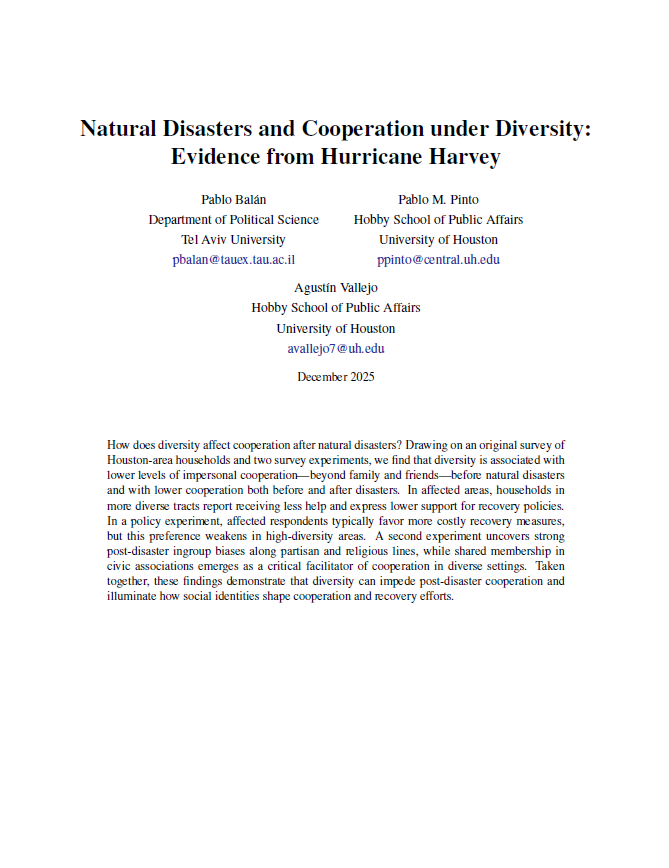
Natural Disasters and Cooperation under Diversity:Evidence from Hurricane Harvey Abstract: Under what conditions does disaster exposure shape cooperation? A large literature examines the relationship between disasters and cooperation. We study how a key feature of the social environment—ethnic diversity—moderates the relationship between disaster damage and cooperation. We argue that diversity shapes different forms of cooperation depending on the feasibility of monitoring. When monitoring is feasible, as in face-to-face interactions, we do not predict a systematic relationship between diversity and cooperation following shocks. By contrast, when monitoring is more difficult, as in the provision of public goods such as climate adaptation policies, we predict a diversity penalty: following shocks, cooperation is lower at higher levels of diversity. We examine these predictions using observational and experimental data from Hurricane Harvey, which generated substantial variation in local exposure to disaster damage. Consistent with prior work, diversity is associated with weaker pre-disaster cooperation with neighbors. Following the storm, we find no systematic relationship between diversity and interpersonal face-to-face helping behavior, but document a diversity penalty in support for climate adaptation policies. A partner-choice experiment shows that civic-association membership becomes a stronger channel for cooperation in more diverse settings, consistent with associations serving as a monitoring technology. |
|
|
CPP WP 01-2019: Increasing Rural Electrification through Connection Campaigns Brian Blankenship (Columbia University), Ryan Kennedy (University of Houston), Aseem Mahajan (Harvard University), Jason C. Yu Wong (Columbia University), and Johannes Urpelainen (SAIS-John Hopkins University) Abstract: In September 2017, the Indian government launched its “Saubhagya” initiative, aimed at achieving universal rural electrification. However, there is little academic study of strategies to increase electrification rates. We argue that a key and underappreciated barrier to expanding electrification is the transaction costs that households face in applying for a connection. Before applying, households must first obtain information on the costs of an application and the requirements for submitting one. Additionally, distribution companies’ lack of capacity impedes electrification even when households seek connections. We conducted a randomized controlled trial in Uttar Pradesh, consisting of an informational campaign which provided information about the costs and procedure of applying for connections. We find that households exposed to the campaign were three times as likely to apply for a connection, and expressed lower perceptions of the cost and difficulty of applying. However, actual connection rates remained unchanged. The results suggest that transaction costs are an important barrier to electrification, but limited capacity is also an obstacle. |